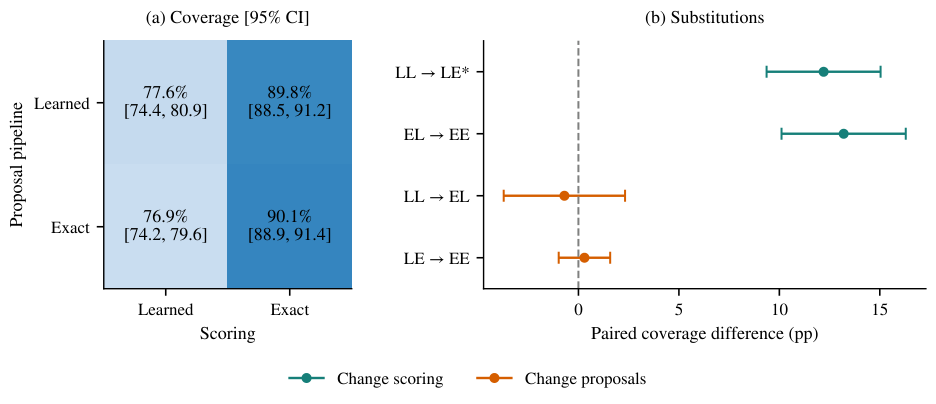
+12.2 pp
Replacing predicted trajectory scores with simulator costs increases coverage. Substituting simulator states in proposal generation alone shows no detected gain.
Paired 95% interval: 9.4 to 15.0 percentage points.
pico-WAM: Evaluating Counterfactual Prediction and Planning Error in a Compact World Action Model
When control fails, is the problem the actions a policy proposes—or the way a world model scores them?
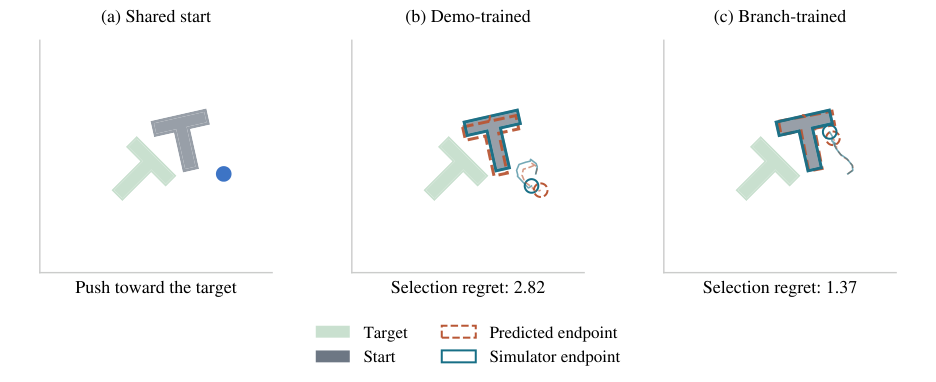
Controlled interventions in Push-T reveal where improvements help. The study uses 206 demonstrations and 15 training seeds.
+12.2 pp
Replacing predicted trajectory scores with simulator costs increases coverage. Substituting simulator states in proposal generation alone shows no detected gain.
Paired 95% interval: 9.4 to 15.0 percentage points.
+4.8 pp
Counterfactual branch training increases the coverage advantage of policy-restarted over warm-started search. Restart wins with both datasets.
Paired 95% interval: 1.5 to 8.0 percentage points.
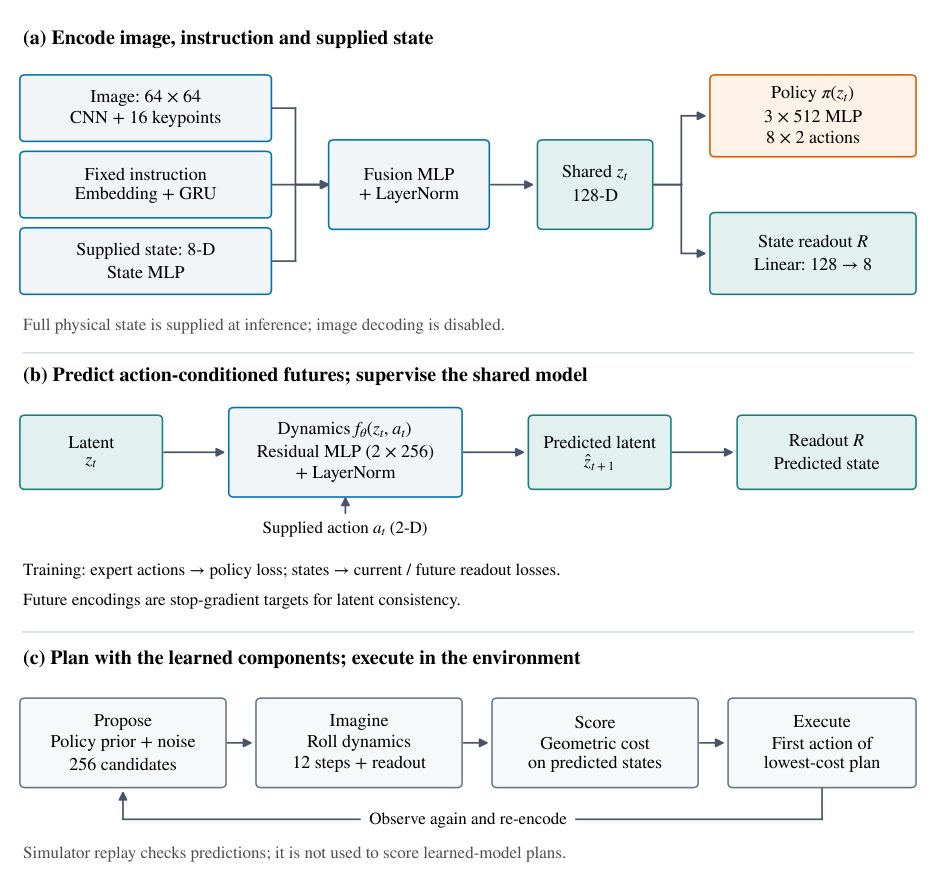
A shared representation connects imitation, action-conditioned dynamics, and a physical-state readout. An external planner compares imagined action sequences.
In Meta-World door opening, noisy-expert data improves candidate ranking and planner success: 88.2% versus 78.6%. Both planners remain below reactive BC at 98.6%.
This uses separate state-space models and fixed data/banks; it does not test transfer of the shared architecture.
Ranking regret includes agent approach as well as block-to-goal distance. Better regret need not mean block motion. Reactive policies and planners also observe at different frequencies.
The primary warm/restart and scoring contrasts hold observation frequency fixed.
When a World Action Model fails at control, is the bottleneck proposal generation or trajectory scoring? We introduce pico-WAM, a compact model with supplied physical state for tracing policy-dynamics interactions. Using 206 Push-T demonstrations and 15 training seeds, we compare data regimes and search configurations. Counterfactual branch training improves short-horizon cost ranking and enlarges the coverage advantage of policy-restarted over warm-started search by 4.8 percentage points; restart wins under both data regimes. Replacing learned trajectory scores with simulator costs improves coverage by 12.2 points while retaining learned proposals. Substituting simulator states in proposal generation alone shows no detected gain. Component diagnostics and a separate door-opening study show why better ranking need not yield better control or outperform imitation. These controlled interventions identify scoring as an effective improvement target in the tested setting and provide a reproducible protocol for diagnosing compact world models.
Read the full PDFFrom an installed checkout, regenerate figures, replay the saved decision, or run a miniature experimental pipeline. Full retraining is documented separately.
Reproduction guide# Regenerate paper figures and numbers
python reproduce.py figures
# Replay the worked decision
python reproduce.py trace
# Run the miniature factorial workflow
python reproduce.py smokeArchived-report regeneration and miniature checks do not establish full independent numerical reproduction. Original pretrained checkpoints are not included.
Installation instructionsKeivalya Pandya · arXiv:2611.01039 · 2026 · Preprint
@misc{pandya2026picowam,
  title = {{pico-WAM}: Evaluating Counterfactual Prediction and Planning Error in a Compact World Action Model},
  author = {Pandya, Keivalya},
  year = {2026},
  eprint = {2611.01039},
  archivePrefix = {arXiv},
  primaryClass = {cs.RO},
  url = {https://arxiv.org/abs/2611.01039}
}